Articles in Volume 1, Issue 1, December 2023
A comparative Life Cycle Assessment of vulnerable dwellings along Davao River Basin using Athena Impact Estimator for Building
Nurvin Zary E. Bustillo
Every year, more and more buildings are built, but many have problems because they are exposed to harsh weather and are used. Some of these problems are cracks, dead holes, and a high level of air infiltration, all of which affect how much energy is used. This study aims to compare the embodied energy (EE) using life cycle analysis (LCA) of a row house model and a walk-up apartment model of housing in the riverine area of the Davao River. Assessment of the tool's life cycle is the research approach used for this investigation (LCA). A life cycle perspective can be helpful in several situations, including but not limited to better appreciating the potential benefits of the repurposing project and its impacts on the environment and providing information for future building stock management. Results have shown that row housing produces more building materials than walk-up buildings, with almost 50% less consumed. The row housing model also has a higher environmental impact when it comes to the assembly areas: foundation, roofing, and flooring materials. Meanwhile, walk-up dwellings contribute more wall components, columns, and beams. The findings of the life cycle assessments revealed that, in general, row housing units were impacted more during the production stage (A1 to A3), with 86% of the total. Throughout the same period, walk-up residences had a higher contribution during the construction phase (A4 and A5) with 11% and beyond the building life (D) with an average of 6%. Both models tie in with 2% for the use category (B2, B4, and B6) and 11% for the end-of-life category (C1 to C4). Row housing units have a greater impact on the surrounding environment than walk-up apartment units, assuming that the same measurement criteria are objectively applied to both models. According to the findings of the study, implementing in-situ vertical development in sensitive areas is preferable because it involves less material consumption and has a smaller negative impact on the surrounding environment.
Life Cycle Analysis, Sustainability, Climate Change, Vulnerable Housing, River Basin



Development of Automatic Object Lifter
Rogelio A. Lasaga Jr, Mark Cleo B. Suansing, Peter G. Talucod, Richard T. Regidor
Food service is the most significant part of running a successful restaurant. Precise and consistent food order distribution must be synchronized to achieve a remarkable operation. As the food business industry develops, the quality of the technology goes down. It now becomes the burden of the owners, especially on the workers. Developing an automated dumbwaiter with High Torque DC Motor and 1-kg load cell w/ HX711 Amplifier was conceptualized to solve this problem. The study aims to design, fabricate, and test the functionality of an Arduino-based automatic object lifter that will convey the corresponding meal to the following floor. The circuitry comprises an Arduino Uno, 1-kg Load Cell, HX711 Load Cell Amplifier, LCD Display 20x4 HD44780 Controller, Rotary Switch, Limit Switch, L298N Motor Driver, and a High Torque DC Motor. The system begins to operate after the load cell is calibrated. After this, the food was placed on a tray over the top of the dumbwaiter with a 1-kg load cell underneath. The meal weights will be set accordingly and saved as data when the microcontroller analyses the values given by the load cell and HX711 module. The dumbwaiter has only three meals available. Every meal comprises three different combinations of food items per tray, for a maximum of 1 kg. For the first meal: 1-pc Chicken w/ Rice & Drinks, second meal: Spaghetti w/ Fries & Drinks, and the third meal: Burger w/ Fries & Drinks. Whenever there are discrepancies in the weights of the food items, it prevents the system's operation. The dumbwaiter carries the meals up to the next floor. As the dumbwaiter hits the plunger of the limit switch, it instantly stops. Generally, the prototype was functional, with an average transport time of 13.584 seconds and a limit switch-breaking system of 0.5 milliseconds.
Food Service, Arduino Uno, DC Motor, Load Cell, Dumbwaiter

Development of Kennel Cage Cooling System Using Thermoelectric Cooler
Dave Costan, Mariah Vernette Isaac, Lyka Kristy Bagares, Richard T. Regidor
Animal welfare is one of society's top priorities nowadays; hence, pets have been considered part of every family's household. Pet safety and its condition are frequently monitored, and many innovative inventions are being created. A Peltier module, commonly known as a thermoelectric cooler, is widely used in cooling modules. A thermoelectric cooler is used to produce cold air to give comfort to their cages. Installing a cooling system with a control system creates cool air inside the cell with a fan. The temperature inside the cage can be manually controlled depending on the desired temperature, between 20 and 25 degrees Celsius. Using t-test analysis, the results show that the thermal reading of the developed device is accurate and the system is fully operational. However, outdoors may affect the task; the Peltier may produce less coldness and vary according to the kennel cage design and size.
Peltier Module, Thermoelectric cooler, Kennel cage

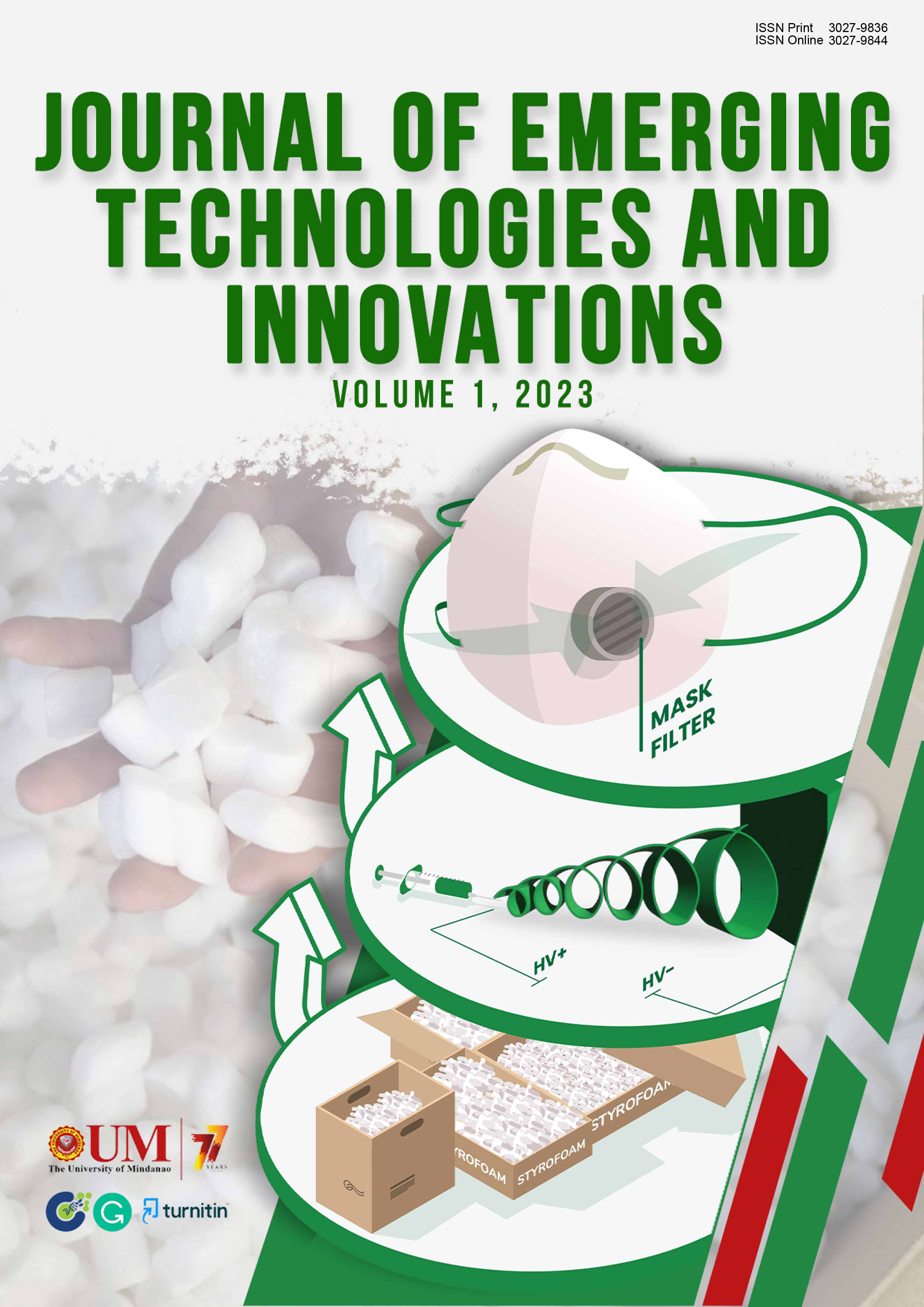
Chitosan-coated electrospun waste Polystyrene microfiber as mask filter
Joaldine Albacite, Kristyl Ann Dalid, Shaira Mae Samon, Chosel P. Lawagon
Waste expanded polystyrene is one of the significant contributors to global waste. Its disposal has been a problem due to its low density causing too much space take up in landfills. The utilization of waste-expanded polystyrene as a mask filter through electrospinning process is done in this study. It is annealed and coated with chitosan to improve mechanical strength and bacterial filtration efficiency. The annealed fiber mat has an average fiber diameter of 2.80 +/- 1.24 um while the annealed and coated fiber averaged 3.52 +/- 1.87 um. The bacterial filtration efficiency test shows 99.84 +/- 0.22% efficiency for the coated filter and 64.58 +/- 8.84% efficiency for the non-coated filter. The results imply that incorporating chitosan significantly improved the filtration efficiency of the filter. Moreover, the addition of chitosan increased the ultimate tensile strength from 0.72 +/- 0.08 MPa to 9.86 +/- 1.24 MPa and turned the hydrophobic EPS microfiber (89.83 +/- 1.48 degrees contact angle) to a hydrophilic microfiber (51.61 +/- 4.47 degrees contact angle). On the other hand, there is no significant difference in the differential pressure between the coated (5.40 +/- 0.17 mm H2O per cm2) and non-coated (5.58 +/- 1.54 mm H2O per cm2) mask filter. Adding chitosan does not increase the pressure drop across the filter. Lastly, the produced chitosan-coated waste-expanded polystyrene mask filter qualifies for ASTM Level 3 for medical and surgical masks in terms of bacterial filtration efficiency and differential pressure. Thus, the electrospun EPS microfiber mask filter can potentially be applied to standard surgical masks while presenting a simple and environmentally friendly waste EPS upcycling.
Waste Expanded Polystyrene, D-limonene, Chitosan, Electrospinning, Mask Filter